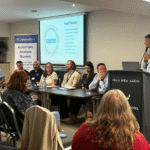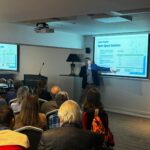
Earlier this month, our team including Andrew Paul and Robyn Dennehy had the fantastic opportunity to attend the Safe Software Peak of Data Integration and AI Conference in Seattle, Washington.
With jam-packed sessions, global insights and powerful demonstrations, it was an energising experience for both, with each bringing back unique learnings and inspirations to share.

Both Andrew and Robyn delivered excellent presentations, highlighting the FME projects that they worked on the past few months. Andrew gave a presentation on “Land and Property Management with FME”, while Robyn presented “Automating the Placement of Medical Interns”.


We asked the team to report their key highlights from the event under each of the following headings.
Favourite New Feature:
Robyn: It is tricky to pick just one new feature as a favourite and there’s a lot of overlap here with ideas/features our customers would love.
Data virtualisation is being widely marketed ahead of its release with 2025.1, and with good reason. Organisations will be able to build secure REST APIs through FME’s no-code interface. It will be incredibly powerful for functions such as enabling real time access to data sources/filtered data views and secure AI platform integration.
I was also excited to see that one click HTTPS configuration will be coming on stream shortly. At present, administrators carry out several different steps depending on the certificate type to enable HTTPS on their FME Flow instance. This takes place after FME Flow is installed. This one click solution, available from 2025.1, will allow administrators to configure HTTPS, with one click, during installation of FME Flow on their server. Distributed installations will also benefit from an improved configuration process.


Andrew: The most exciting new development in FME 2025 for me was the introduction of Data Virtualisation capabilities in FME Flow. This was announced in the keynote session as it is such a game changer for Safe Software.
What it means in simple terms is that FME Flow can now expose the results of a workspace as a virtual API or live service, allowing other systems or users to query the data on demand. This is a major shift from FME’s traditional extract-transform-load (ETL) model. FME Flow becomes not just a processing engine, but a live data service provider.
This means you can dynamically create and deliver interactive charts, maps, or dashboards in a visual format without needing to build separate front-end systems. This is part of the 2025 beta release, and I am looking forward to testing the capabilities of this feature on FME Flow.
Favourite Presentation (and why):
Robyn: One Map to Rule Them All: Improving Infrastructure Planning and Resilience in New Zealand (Angus Bargh – Founder of Open Plan, Keith Hastings – Geospatial Developer with Jacobs).
This presentation shared details around the creation and function of the National Forward Works Viewer (NFWV) in New Zealand. It is a single authoritative source of upcoming infrastructure projects which can be used by organisations and the public to determine upcoming work to be carried out locally on utility/road networks. Communities had previously found it difficult to coordinate these projects which then impacted road users, businesses and communities, while also increasing carbon emissions and affecting the local economy. Digital Built Aotearoa (a not-for-profit foundation) utilises the FME platform to ingest, aggregate and map these projects into a spatial Viewer which provides visibility of these projects to end users. This type of visibility has many benefits including enabling clash and opportunity detection, reduction in disruption, avoiding costly rework and improving asset longevity.
The presentation stood out to me because the foundation of the NFWV came from a missing piece in rebuilding communities after an earthquake hit a region of the country. There wasn’t a single source location for data that could be shared with agencies to plan the reconnection of utility/road networks. The spatial viewer was created by DBA for local authorities in that area at the time of the rebuild. It was instrumental in providing a coordinated effort in the region. However, the platform has grown now with more and more local authorities across New Zealand signing up and submitting forward planning data. The NFWS symbolises a mindset shift when it comes to data, that collaboration rather than silos can have such a positive impact. This viewer is becoming instrumental in day-to-day planning for local authorities across New Zealand. I believe it has the potential to be utilised for collaboration across more than just forward planning data as the platform continues to gain popularity.
Andrew: The presentation that left the greatest impact on me was delivered by Jesse Hamlin from The HALO Trust, showcasing their incredible use of FME in humanitarian demining efforts. HALO’s mission is to rid the world of landmines and explosive remnants of war. Jesse gave us practical examples of how FME is helping them collect, clean, and analyse data across some of the most dangerous regions.
What stood out was how FME empowers their field teams to process spatial data from legacy systems and GPS devices, allowing them to map hazardous areas more accurately and make faster, safer decisions. It was a powerful reminder of how geospatial technology, and FME in particular, can truly make a difference not just in business workflows, but in saving lives.
Something New You Learned:
Robyn: When attending the Building Data Products Powered by FME presentation by Gavin Jeter (Locus), I learned about how Build Farms can be used with FME to carry out processing heavy workflows in much faster timeframes. As an FME user from a GIS background, I am still learning about the optimisation of FME workflows on infrastructure in different customer’s environments. Hearing about how Build Farms took years of processing time down to hours for Gavin, had me jotting it down to remember to look into it in more detail. More and more organisations are having to handle larger quantities of data and depending on the organisation’s capacity, a solution including Build Farms could be vital in processing large amounts of data.
Andrew: While I’ve worked with remote sensing data throughout my career classifying objects in satellite and aerial multispectral imagery, I didn’t realise just how powerful the AI integration has become in FME for image analysis.
Safe software demonstrated this at the conference by showing us the ability to upload an image into a workspace of a worker about to enter a factory site and using the HTTP caller were able to pass the image to an AI tool to detect if the employee had the correct PPE to be allowed to work on the site. The PPE was then outputted as 3 vector rectangles which were attributed with the type of PPE e.g. hard hat, goggles, gloves…etc. This then allows the end users to develop a workflow to produce a report to state if the worker has passed the requirements to enter the site.
This is incredibly powerful and can be rolled out to large sites with 1000s workers and will allow employers to monitor compliance. This is incredibly advanced image classification that I couldn’t have imagined with traditional remote sensing techniques that can be adapted for use in many different workflows – including traditional remote sensing!
Top Tip or Idea Our Customers Would Love:
Robyn: FME Form end users will be able to connect directly to knowledge base articles and FME Academy from within their own workbench. While it may seem like something small, this integration between the two makes it easier to troubleshoot, learn best practices and helps empower FME users in an organisation when authoring and building processes. AI Assist in FME Form will also provide context aware responses when working with transformers and parameters. I think this new feature will be really nice functionality to have for new and seasoned FME users alike.
Andrew: One of the most impactful new features for our customers in FME 2025 is going to be the PDF Styler and update to the PDF Writer. It allows you to create fully designed, multi-page PDF reports from your data, all within FME for the first time ever.
I know many of our customers use FME for reporting property summaries, asset reports or planning notices already and sometimes output these in HTML, Word and Excel formats but would love to be able to produce PDFs that have corporate logos, styling and can display charts, maps and all the information they require from their data. The update of the writer and introduction of the styler tool means all this can be done within FME. I know our customers are going to love this and it is already available on FME Form 2025 to implement into workflows now.
In Summary:
The Safe Software FME Conference reminded the team just how innovative and collaborative the FME community is. Whether you’re a seasoned user or just getting started, the possibilities continue to expand, and the team are excited to bring these learnings back to our customers and partners.